How to Master Trading Confluences in 2026 with TJR's 18-Minute Breakdown
Want articles like this for your own video to promote it on YouTube and Google? Order them through the Telegram bot @sat_sit_bot. It writes articles around your video, embeds the video and publishes them on popular niche websites (no ads). Free trial — 50 articles.
· based on the channel TJR
Key takeaways
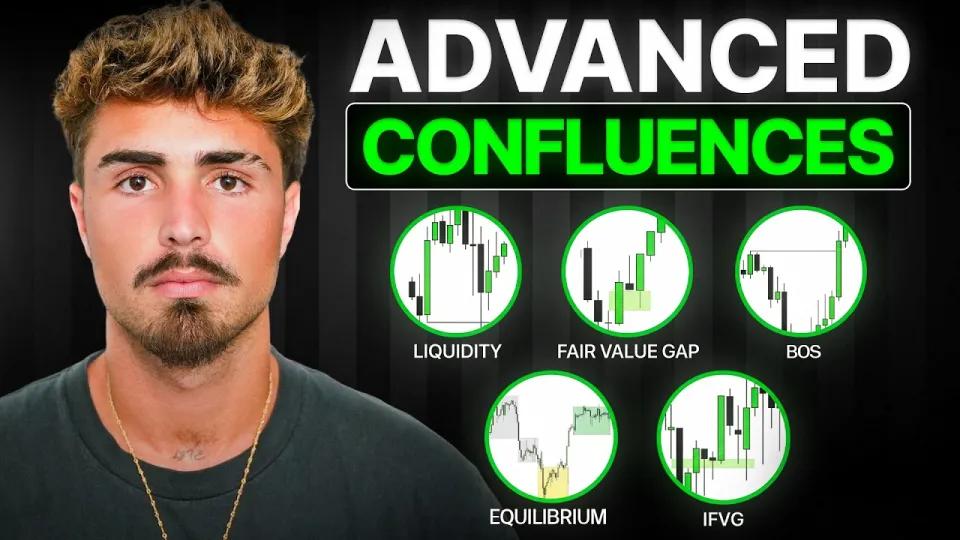
- TJR's video covers five key confluences: liquidity, fair value gaps (FVG), inverse FVGs (IFVG), equal highs/lows, and break of structure (BOS).
- Confluences are areas where multiple technical signals align, increasing the probability of a successful trade.
- Liquidity pools form around obvious highs/lows where stop-losses and pending orders cluster.
- Fair value gaps are price imbalances that often get filled before the trend continues.
- Inverse FVGs act as support/resistance after a failed fill, while BOS confirms trend direction.
Trading confluences are multiple technical signals that align to create a high-probability trade setup. In his 18-minute video, TJR breaks down every major confluence—liquidity, fair value gaps (FVG), inverse FVGs (IFVG), equal highs/lows, and break of structure (BOS)—so you can spot them quickly and combine them effectively. For a structured learning path, grab TJR's free blueprint at go.tjrtrades.com/blueprint-nviugv1.
What Are Trading Confluences and Why They Matter
A confluence is simply a point where two or more independent technical factors point to the same price level or direction. The more confluences you have, the higher the odds that the market will react there. TJR emphasizes that no single signal is enough—you need a cluster of evidence to justify a trade. This approach reduces false signals and improves consistency.
Liquidity: The Magnet for Price
Liquidity refers to areas where stop-loss orders and pending orders cluster, typically around obvious swing highs and lows. Price often gravitates toward these zones to trigger stops before reversing. TJR explains that liquidity pools act as magnets, and smart traders anticipate moves toward them rather than chasing breakouts. Key types include equal highs/lows, trendline liquidity, and round numbers.
Fair Value Gaps (FVG): The Imbalance That Gets Filled
A fair value gap is a three-candle pattern where the wicks of the first and third candles don't overlap, leaving a gap in the middle. This gap represents an imbalance—one side of the market was so aggressive that price moved without trading on the other side. TJR notes that price often returns to fill the FVG before continuing in the original direction. Traders use FVGs as entry zones or take-profit targets.
Inverse Fair Value Gaps (IFVG): When Support Becomes Resistance
An inverse FVG forms when price fails to fill a regular FVG and instead breaks through it, turning the gap into a support or resistance zone. TJR highlights that IFVGs are powerful because they trap traders who expected the gap to be filled. Once an FVG is invalidated, it often acts as a strong level for entries in the opposite direction.
Equal Highs and Lows: Liquidity Pools in Plain Sight
Equal highs or equal lows occur when price creates two or more peaks or troughs at nearly the same level. These levels are obvious to retail traders, making them prime targets for liquidity grabs. TJR explains that smart money often pushes price through these levels to trigger stops before reversing. Recognizing equal highs/lows helps you avoid being the liquidity and instead position yourself with the institutions.
Break of Structure (BOS): Confirming the Trend
A break of structure happens when price breaks a previous swing high (in an uptrend) or swing low (in a downtrend), signaling a potential continuation. TJR uses BOS to confirm market direction and to validate other confluences. For example, a BOS followed by a retracement into an FVG creates a high-probability entry. BOS is not a standalone signal—it works best when combined with liquidity and imbalance concepts.
Common Questions from Traders
Many traders wonder which confluence is most important. TJR suggests that liquidity and FVGs are foundational, but the real edge comes from combining them. Another common question is how to avoid analysis paralysis—the answer is to focus on two or three confluences that align with your strategy. Traders also ask about the reliability of BOS in ranging markets; TJR advises waiting for a clear break with momentum before acting. Finally, discipline and risk management are repeatedly stressed: no confluence guarantees a win, so always use stop-losses and proper position sizing.
Useful Links
- TJR's Blueprint for Full-Time Trading
- Indicators TJR Uses Daily
- Enter Funded Account Raffle
- 10% off Alpha Futures Funded Accounts
- 40% off Lucid Trading
- 30% off Tradeify Funded Accounts
- Trading Journal TJR Uses
- Broker TJR Uses
Final Thoughts
Mastering trading confluences takes practice, but TJR's breakdown provides a clear framework to start. Focus on liquidity, FVGs, IFVGs, equal highs/lows, and BOS, and always combine them with strict risk management. For a step-by-step system to becoming a consistently profitable trader, check out TJR's blueprint at go.tjrtrades.com/blueprint-nviugv1. Remember, trading involves risk, and most day traders lose money—educate yourself and trade responsibly.
Source: Learn Every Trading Confluence In 18 Minutes · Markdown version
Questions & answers
What is the most important trading confluence?
There is no single most important confluence; the power comes from combining them. Liquidity and fair value gaps are foundational, but TJR emphasizes that the real edge is in how you stack multiple confluences together. Focus on two or three that align with your strategy.
How do I avoid analysis paralysis when using multiple confluences?
Start by mastering one or two confluences, such as liquidity and FVGs, before adding more. Use a checklist to confirm setups and stick to a predefined plan. TJR suggests that simplicity and repetition beat trying to analyze everything at once.
Is break of structure (BOS) reliable in ranging markets?
BOS is less reliable in choppy or ranging markets because false breaks are common. TJR advises waiting for a clear break with strong momentum and preferably a retest before acting. Always combine BOS with other confluences like liquidity or FVGs.
How long does it take to become profitable using confluences?
There is no fixed timeline—it depends on your dedication and practice. Many traders take months or years to become consistently profitable. TJR stresses that discipline, risk management, and continuous learning are key, and most day traders lose money, so approach with caution.